
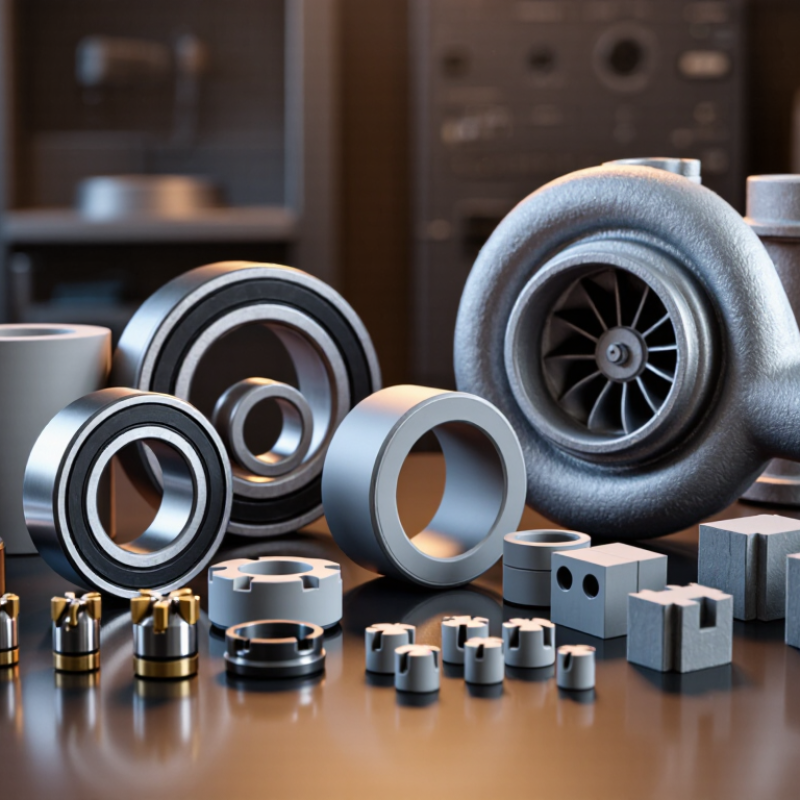
Top Silicon Nitride Types for Global Buyers in 2026
Global buyers should select silicon nitride by application, not by price alone. Powder grade, reaction-bonded, pressureless-sintered, and hot-pressed types behave differently. Ceramic bearing parts need high purity, low porosity, and consistent dimensional control. Cutting tools require hardness, fracture resistance, and stable performance at elevated temperatures. For thermal components, buyers should examine thermal conductivity and thermal-shock resistance. A lower-cost grade can become an expensive decision.
Grand View Research’s 2024 analysis identifies automotive, aerospace, energy, and medical uses as major silicon nitride demand areas. MarketsandMarkets also forecasts continued market growth through 2028, supported by advanced ceramics and electric-mobility applications. These reports suggest broader demand, but their market definitions differ. Numbers are not perfectly comparable. Buyers should check test methods before trusting a specification sheet.
Supplier evaluation needs measurable evidence. Request alpha-to-beta phase data, oxygen content, particle-size distribution, density, flexural strength, and Weibull statistics. Confirm whether results come from production batches or laboratory samples. ISO 9001 certification supports process control, but it does not prove application performance. Ask for lot traceability, sample retention, packaging details, and lead-time records. Regional warehousing can reduce delays, although it may increase handling risk. The best choice is rarely the strongest material on paper. It is the grade that remains stable across real batches, real temperatures, and real delivery conditions.